


The Art of Looking


Discovering Your Own Visual Language
Have you ever stood in front of an artwork and thought:
The Art of Looking
Discovering Your Own Visual Language
Have you ever stood in front of an artwork and thought:
I don't know why, but I really like it.
Or perhaps:
I don't understand it.
Maybe you have even found yourself looking around a gallery, wondering what you are supposed to see.
If so, you are not alone.
We often imagine that understanding art requires a certain knowledge — knowing the artist, the period, the symbolism, the terminology, or what the artwork is “about”.
But there is another way to approach art.
You can begin simply by looking.
You don't need to know the right answer. In fact, there may not be one.
An artwork can be an invitation rather than a question that needs to be solved.
It can make you remember something. It can disturb you, calm you, intrigue you or make you feel something you cannot quite name. You might love one part of it and dislike another. You might not want it in your home at all, yet find yourself unable to stop looking at it.
All of these responses are part of experiencing art.
The more we learn to notice them, the more articulate we become about our own taste.
And this is where visual literacy begins.

Start with what you see
The first response to an artwork is often the most immediate.
Something catches your eye.
Perhaps it is a particular colour, a face, a shape, a horizon or a tiny detail hidden within the image.
Don't rush past that first response.
Ask yourself:
What did I notice first?
Where did your eye go?
What made you stop?
You might notice that you are drawn towards a particular colour. Perhaps it is the deep blue of the ocean, a warm golden glow or a small area of red.
You might notice that you are drawn to the subject.
Or perhaps it isn't the subject at all. Maybe it is the way the paint has been applied, the composition, the light, the space or the feeling of movement.
At this stage, there is no need to explain why.
Just notice.
I am drawn to this.
That is enough.
Move from “I like it” to “I wonder why”
“I like it” is not a shallow response.
It is a beginning.
The next step is curiosity.
Instead of asking:
Do I like this?
try asking:
What is it that I am responding to?
You may discover that your response is more complicated than you first thought.
Perhaps you like the colours but not the subject.
Perhaps you love the atmosphere but find the composition uncomfortable.
Perhaps you don't particularly like the artwork, but something about it keeps bringing you back.
Perhaps it feels beautiful, but also slightly unsettling.
Perhaps you would never put it in your own home, yet you find it fascinating.
This is where our understanding of taste begins to expand.
Taste isn't simply a choice between like and dislike.
There is a whole spectrum in between.
And learning to recognise that spectrum can help us understand not only art, but ourselves.
What does the artwork make you feel?
Now allow yourself to move beyond what you can see.
How does the artwork make you feel?
Don't worry about finding the perfect word.
Start anywhere.
Calm.
Curious.
Nostalgic.
Melancholic.
Joyful.
Uneasy.
Protected.
Lonely.
Hopeful.
Restless.
Peaceful.
Perhaps it feels familiar, even though you have never seen the image before.
Perhaps it reminds you of somewhere.
Perhaps it makes you think of childhood, the ocean, a person you love, a particular season or a time in your life.
Sometimes an artwork can bring a feeling to the surface before we understand where that feeling has come from.
You don't have to force an explanation.
Just notice it.
Give the feeling an image of its own
This is one of my favourite ways of exploring an artwork.
If you cannot quite name the feeling, try describing it as something else.
What would the feeling look like if it were a landscape?
Would it be a still lake at dawn?
A storm approaching across the ocean?
A warm room filled with afternoon light?
A long road disappearing into mist?
Perhaps the feeling is like a sound.
A whisper.
A distant wave.
A cello.
Birdsong.
Or perhaps it is a texture.
Velvet.
Sand.
Weathered timber.
Glass.
Rough stone.
You can even use a metaphor or simile.
The painting feels like standing alone beside the ocean.
The colours are like the last light of the day.
The movement in the painting feels like wind passing through long grass.
These descriptions may not be technically “correct”.
They don't need to be.
They are your way of making sense of what you are experiencing.
And sometimes our most personal descriptions can tell us more about why an artwork speaks to us than a page of art terminology.

Look beneath the feeling
Now we can begin to investigate.
What might actually be creating this response?
This is where the language of art becomes useful.
You may have heard of the elements and principles of art.
The elements are some of the visual ingredients an artist works with:
The principles describe some of the ways these ingredients can be organised:
Balance.Contrast.Movement.Rhythm.Pattern.Emphasis.Scale.Unity.
You don't need to memorise them.
Think of them simply as a vocabulary for looking.
If you are drawn to a painting because it feels peaceful, for example, ask yourself:
What is creating that sense of peace?
Is it the limited colour palette?
The open space?
The horizontal lines?
The balance within the composition?
The softness of the edges?
The quietness of the subject?
Perhaps several things are working together.
Suddenly, “I like it” has become something more specific.
I think I like this because the open space and quiet horizontal lines make me feel as though I can breathe.
That is visual literacy.
Follow your eye
One of the simplest things you can do when looking at art is to follow where your eye travels.
Look at the artwork slowly.
Where do you arrive first?
Where do you go next?
Does your eye move in a particular direction?
Does it circle back?
Is there somewhere you keep returning to?
Artists can guide the movement of the eye through colour, line, shape, contrast, scale, light and composition.
Sometimes that movement is obvious.
Sometimes it is almost invisible.
You might discover that you love an artwork because your eye has somewhere to wander.
Or perhaps you prefer an artwork where everything feels still and contained.
Neither response is more sophisticated.
They are simply different ways of seeing.
Look at how the artwork has been made
There is another layer of looking that is often overlooked.
How has the artist actually made the work?
Move closer if you can.
Look at the surface.
Can you see the brushstrokes?
Are they smooth and controlled, or energetic and visible?
Is the paint thin or heavily layered?
Are the edges sharp or soft?
Does the surface feel polished, raw, textured, luminous or rough?
Does the artist allow parts of the underlying surface to remain visible?
Look at the direction of the marks.
Do they follow the movement of the subject?
Do they create tension?
Do they create rhythm?
The physical way an artwork is made can influence how we experience it emotionally.
A loose, sweeping brushstroke can create movement.
A carefully controlled edge can create stillness.
Thick layers of paint can give a surface weight and presence.
Fine, delicate marks can create fragility.
Once you begin noticing these things, paintings become much more than images.
You begin to see the decisions within them.

You don't have to understand everything
This is perhaps the most important thing I would like to say.
You do not have to understand an artwork completely in order to have a meaningful experience with it.
Sometimes we place too much pressure on ourselves to discover what the artist intended.
Of course, context can be fascinating.
Knowing something about an artist, their life, their culture or the circumstances in which a work was created can open another door.
But it is not the only door.
Your experience matters too.
Two people can stand in front of the same painting and see entirely different things.
One person may see freedom.
Another may see loneliness.
One may see beauty.
Another may feel uneasy.
One may be reminded of the sea.
Another may be reminded of home.
Neither person necessarily needs to be corrected.
Art can hold more than one experience.

From wondering to exploring
Perhaps we could replace the question:
“What does this artwork mean?”
with:
“What can I discover by spending time with it?”
That small change can make looking at art feel much less intimidating.
You are no longer trying to pass a test.
You are exploring.
Look.
Notice.
Feel.
Question.
Look again.
The longer you spend with an artwork, the more you may begin to notice.
Something you didn't see at first may suddenly become important.
A colour may begin to feel different.
A small detail may change the way you understand the whole image.
Your first response may soften.
Or it may become stronger.
This is one of the quiet pleasures of looking at art.
The artwork hasn't necessarily changed. Your way of seeing it has.
Your taste is allowed to change
Our visual tastes aren't fixed.
They can change with age, experience, memory, travel, relationships, our homes and the things we encounter along the way.
You may discover that the colours you once avoided now draw you in.
You may become fascinated by work you once found difficult.
You may begin to appreciate abstraction, minimalism, surrealism, portraiture or landscapes without knowing exactly when that change occurred.
There is no need to define your taste too rigidly.
You can simply become more aware of it.
Perhaps you begin to notice:
I am drawn to atmospheric spaces.
I love quiet colours.
I like paintings with a sense of mystery.
I am attracted to strong movement.
I love the tension between beauty and something slightly unsettling.
I prefer work that leaves room for my own imagination.
These observations become part of your own visual language.
A little exercise in looking
The next time you encounter an artwork, try spending a few quiet minutes with it.
You could use these questions as a starting point.
LOOK
What do I notice first?
PAUSE
What keeps attracting my attention?
FEEL
What emotion or sensation does the artwork create?
IMAGINE
If this feeling were a place, weather, sound, texture or memory, what would it be?
INVESTIGATE
What colours, lines, shapes, textures, spaces or contrasts might be creating this response?
FOLLOW
Where does my eye travel through the artwork?
NOTICE
How has the artist made the work? What can I see in the brushwork, surface or mark-making?
QUESTION
What am I curious about now?
RETURN
Has my response changed after looking for longer?
There is no answer sheet.
No grade.
No right interpretation.
Just an opportunity to look a little more closely.
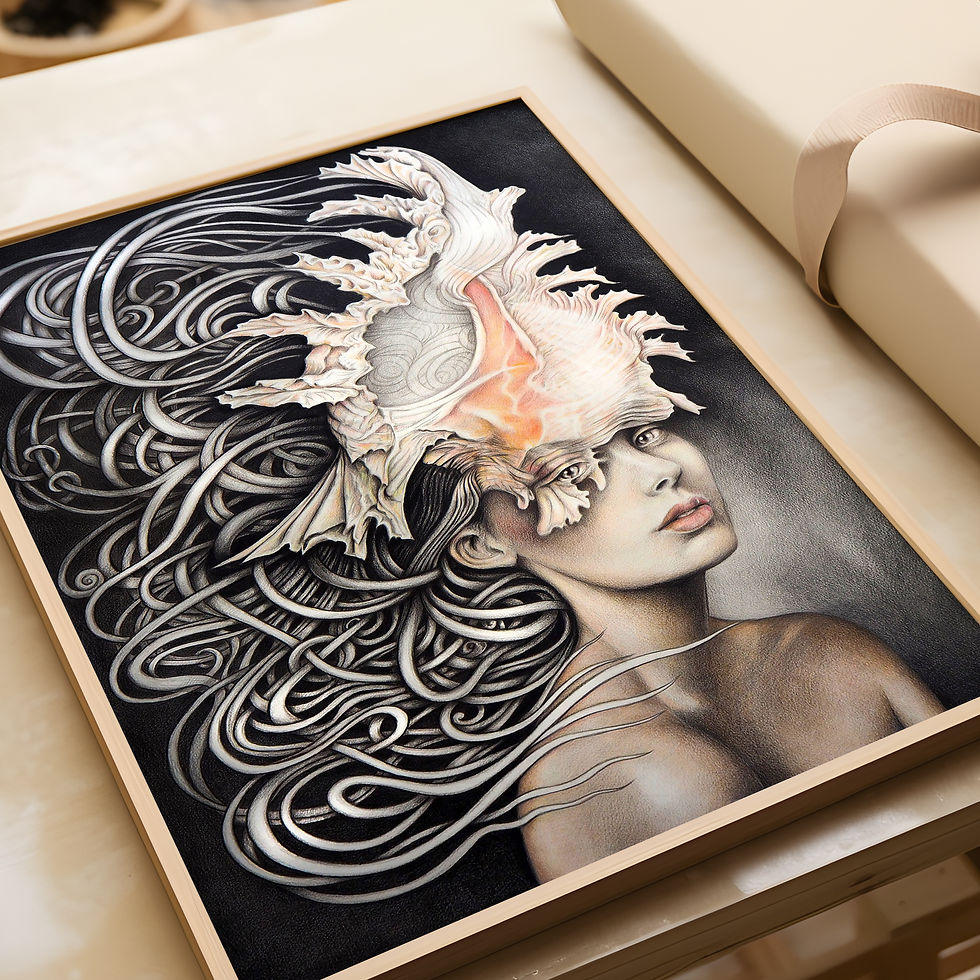
Perhaps understanding art is really about learning to see
Visual literacy isn't about turning everyone into an art expert.
It is about becoming more attentive to what we see and more confident in expressing what we experience.
It gives us words for things we may have felt for years but never quite known how to describe.
And perhaps, once we begin looking this way, something else happens too.
We start noticing the world differently.
The colour of evening light on a building.
The rhythm of shadows across a wall.
The shape of clouds before rain.
The repetition of windows along a street.
The movement of water.
The texture of an old door.
The strange beauty of something we might normally walk past without seeing.
Art can teach us to pause.
To look again.
To become curious.
And sometimes, to discover that the things that move us visually are connected to something much deeper within us.
So the next time you stand in front of an artwork and think,
I don't know why I like this...
don't dismiss the thought.
Stay with it.
Perhaps that is where the looking begins.
Not with knowing what art means, but with discovering what it means to you.

Continue exploring
If you would like to explore some of the ideas behind my own paintings, you can wander through Symbolism of Shells, The Ocean & the Subconscious, and Time & Transformation.
Download
The Art of Looking — A Quiet Guide to Exploring Art


Comments